Wechat and Alipay wild card binding services are upgraded, and 3% handling fee is exempted for single 200 yuan.
Important progress has been made in facilitating overseas users to pay in mainland China. Alipay and WeChat Pay, the third-party payment platforms, have successively upgraded their business in binding foreign cards.
On July 20th, according to the official news of WeChat payment, the service of WeChat payment for foreign cards has been upgraded in an all-round way. At present, overseas users can use WeChat payment to bind international bank cards, and most merchants in the domestic fields including catering, transportation, wine travel and supermarkets can use mobile payment. At the same time, foreign card users can also use a variety of payment methods, such as scanned code and scanned code, small program payment, confidential withholding, in-app payment and so on.
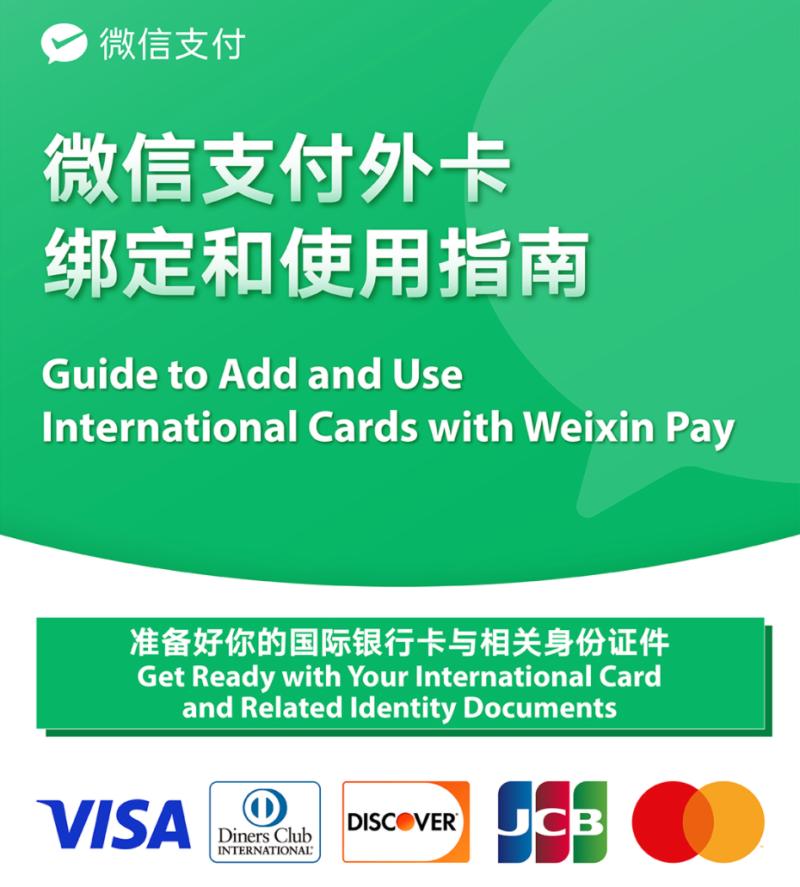
(Source: WeChat Open Class)
The guide to binding and using foreign cards issued by WeChat Pay shows that it only takes three steps for foreigners to bind foreign cards through WeChat Pay. One is to download or update WeChat /WeChat application, the other is to find the WeChat payment portal, and the third is to fill in identity information and bind cards. The supported wild cards include VISA, DinersClub, Discover, JCB and Master.
At present, foreigners can use six kinds of documents, including passports, Hong Kong and Macao residents’ passes to and from the Mainland, mainland travel permit for taiwan residents, Hong Kong and Macao residents’ residence permits, Taiwan Province residents’ residence permits, and foreigners’ permanent residence permits, to open WeChat payment. The mobile phone number that needs to be verified in the process of card binding can only accept SMS verification code, and it does not have to be Chinese mainland mobile phone number.
It is understood that the use of foreign cards through WeChat payment will have a certain limit, which is a single 6,000 yuan, a monthly cumulative 50,000 yuan, and an annual cumulative 60,000 yuan. The payment exchange rate is calculated by the card organization and the issuing bank of the foreign card.
Regarding the handling fee that the outside world is concerned about, WeChat Pay said that in order to support the small and high-frequency consumption demand of foreign card users, WeChat Pay will bear the handling fee for foreign card transactions with a single transaction amount of RMB 200 yuan or less. This also means that the user’s single transaction amount is less than or equal to 200 yuan’s free handling fee; A handling fee of 3% will be charged when the amount of a single transaction is greater than that of 200 yuan. If the user initiates a refund, the handling fee will be refunded in proportion.
In May of this year, Alipay also released "One Map to Understand Alipay Binding Wild Card", and its wild card service is basically consistent with WeChat payment in terms of recommended usage scenarios, handling fee collection and exchange rate calculation. However, among the types of foreign cards supported, WeChat payment has increased the JCB card compared with Alipay, and the transaction limit is 3,000 yuan for Alipay and 6,000 yuan for WeChat payment.
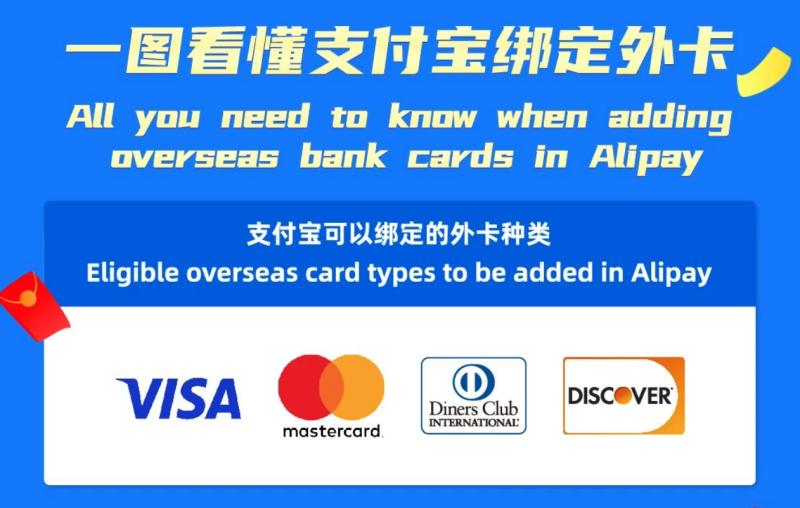
(Source: Alipay)
Different from consumer payment, at present, foreign cards can’t use functions such as red envelopes, financial management and transfer in Chinese mainland.
From this point of view, key progress has been made in facilitating the consumption and payment of overseas users to Chinese mainland. Prior to this, according to the reporter’s understanding, because of the epidemic situation, the demand for use decreased, and many POS machines supporting foreign card payment in China were removed due to maintenance costs and other considerations. In addition, the popularity of online payment in China was high. After the increase of cross-border flow this year, some foreigners felt that it was inconvenient to spend money in Chinese mainland.
As early as 2019, in the Opinions on Further Stimulating the Potential of Culture and Tourism Consumption, the State Council requested to improve the inbound tourism environment, improve the mobile payment solutions for inbound tourists, and improve the convenience of tourists’ consumption. In 2020, the National Development and Reform Commission also issued a document stating that domestic payment service institutions are encouraged to cooperate with overseas card issuers to provide mobile payment services for overseas tourists on the premise of compliance with laws and regulations.
As early as 2019, WeChat and Alipay explored ways to improve the payment experience of overseas users. However, according to the reporter’s understanding, related businesses have made slow progress due to profit motivation, rates and security issues, and the epidemic has further stranded related work. With the approach of Chengdu Universiade and Hangzhou Asian Games, the attention of related issues has also increased.
At the "2023 Summer Davos Forum" held in Tianjin at the end of June this year, Chen Qiru, vice president of Tencent Financial Technology, revealed that Tencent will open the WeChat payment merchant network to international credit card or debit card organizations such as VISA in July this year, so as to facilitate overseas users to bind WeChat payment with commonly used credit cards and debit cards in mainland China. When the news came out, it caused widespread concern.
According to the reporter’s understanding, in addition to WeChat and Alipay, China Unionpay Quick Pass, a subsidiary of China UnionPay, is also working with banking institutions to explore new functions, which is expected to be launched at the opportunity of the Asian Games to facilitate overseas people to pay online in the mainland. (For details, please refer to the report: "Is it difficult for overseas users to pay online in the Mainland? The Asian Games will be an opportunity for improvement, and third-party payment will have new actions ")