There are heavy rains in Hunan, Hubei, Jiangsu and Anhui, and the sultry weather in South China continues.
CCTV News:According to the news of China Weather Network, while a new stream of cold air moves eastward and southward, the warm and humid airflow also strengthens northward. As a result, the heavy rainfall in the middle and lower reaches of the Yangtze River has once again begun. It is predicted that today (25th) will be the period with the strongest rainfall, with heavy rains in parts of Hunan, Hubei, Jiangsu, Anhui, Shanghai and Zhejiang, possibly accompanied by strong convective weather, and the rain will gradually weaken tomorrow. Because this cold air has little influence on South China, South China is still sultry and difficult to solve today and tomorrow.
This round of rainfall entered the strongest period, with heavy rains in Anhui, Jiangsu and other places.

Since May, there have been frequent rains in the middle and lower reaches of the Yangtze River. Yesterday, the third round of large-scale precipitation started again this month, and the sunshine that just appeared in Jiangsu and Anhui was "driven away" by the rain. Monitoring shows that there are heavy rains in central Jiangsu, northern Shanghai, Anhui along the Huaihe River, southwestern Yunnan and central Hainan Island. There were moderate rains in parts of Xinjiang along the Tianshan Mountains, southern Gansu and eastern Qinghai, and heavy rains in Yili, Xinjiang, Gannan, Gansu and Dingxi, and Huangnan, Qinghai.
Today, the rain is further strengthened, and the scope of heavy rain is even larger. The Central Meteorological Observatory predicts that from 08: 00 today to 08: 00 tomorrow, there will be heavy rains in southeastern Henan, central and southern Jiangsu, Shanghai, northern Zhejiang, central and eastern Hubei, northern Hunan, eastern and southern Guizhou, and northeastern Chongqing. Among them, there will be heavy rains in south-central Anhui, southern Jiangsu, and northern Hunan. Some of the above areas are accompanied by strong convective weather such as short-term heavy precipitation, thunderstorms and strong winds, and the maximum hourly precipitation is 40 ~ 60 mm.
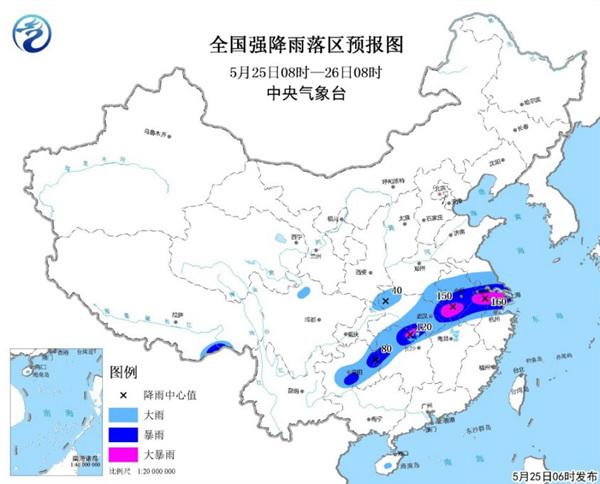
Tomorrow, the rain belt will begin to shift to the south and weaken. It is estimated that there will be moderate to heavy rain from 08: 00 tomorrow to 08: 00 the day after tomorrow in eastern Inner Mongolia, central Northeast China, southwestern Jianghuai, western and north-central Jiangnan, eastern and southern Guizhou, western Sichuan Plateau, central and eastern Yunnan, and central and western South China. Among them, there will be heavy rain or heavy rain (50-120 mm) in northern and western Jiangnan, western South China and eastern Yunnan, and these areas are accompanied by strong convective weather such as thunderstorms and short-term heavy precipitation.
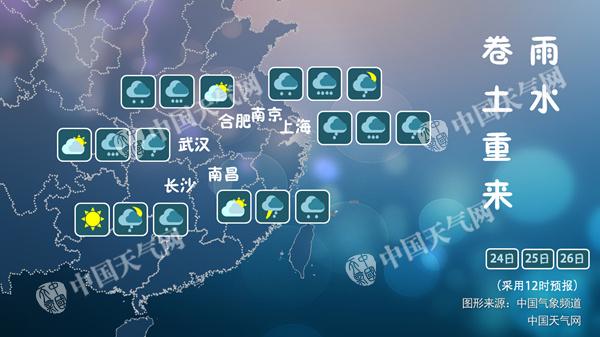
Meteorologists warned that there may be strong convective weather during this round of heavy rainfall, mostly short-term heavy precipitation, but there may also be thunderstorms or hail; Dabie mountain area at the junction of Hubei and Anhui, Wuling mountain area at the junction of Hubei, Chongqing, Hunan and Guizhou need to be alert to the occurrence of geological disasters, and low-lying areas in the plain should also be alert to the occurrence of waterlogging; In addition, heavy rainfall may bring inconvenience to public travel, and it is also necessary to do a good job in the defense of urban waterlogging, lightning and strong winds.
The high temperature in Jiangnan and South China continues to develop, and it feels sultry and uncomfortable.
At present, this cold air affecting China will bring 4 ~ 6 northerly winds to most parts of northwest China, western and northern North China and southern Northeast China, with the temperature dropping by 6 ~ 10℃ and the local temperature above 12℃. However, the southern part of the Yangtze River and southern China are still beyond the reach of cold air, and even if they can barely reach it, it is a spent force, and the cooling capacity is very limited.
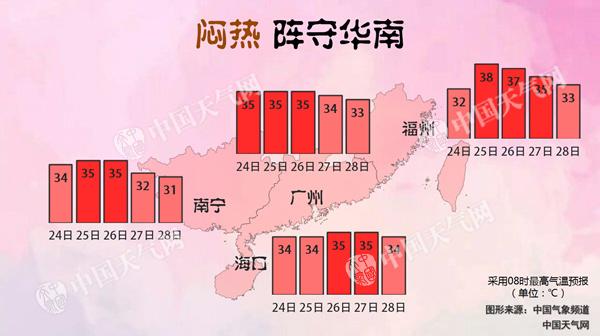
It is estimated that today and tomorrow, South China will still be under the control of subtropical high, and the hot weather will continue. The highest temperature in Fuzhou today may reach 38℃, breaking the record of the highest temperature in May, while Guangzhou may set a new record of continuous high temperature in May. At the same time, the high temperature in the south of the Yangtze River will gradually increase. Among the provincial-level cities, the highest temperature in Changsha and Nanchang today may reach 35℃.
Meteorologists reminded that due to the high humidity and sultry weather, the somatosensory temperature in Jiangnan and South China will exceed the actual temperature, which makes them feel very uncomfortable. The local public should do a good job in heatstroke prevention and cooling, pay attention to drinking more water and keep heatstroke prevention drugs.