Vaccination is related to people’s life and health. The reporter learned from the National Bureau of Disease Control and Prevention that in order to further strengthen the standardized management of vaccination, the National Bureau of Disease Control and Prevention and the National Health and Wellness Commission recently issued the "Guidelines for Vaccination Work (2023 Edition)".
According to the notice issued by the National Bureau for Disease Control and Prevention, the new version of the vaccination work specification issued this time was formed after implementing the relevant requirements of the People’s Republic of China (PRC) Vaccine Management Law and revising the vaccination work specification (2016 edition).
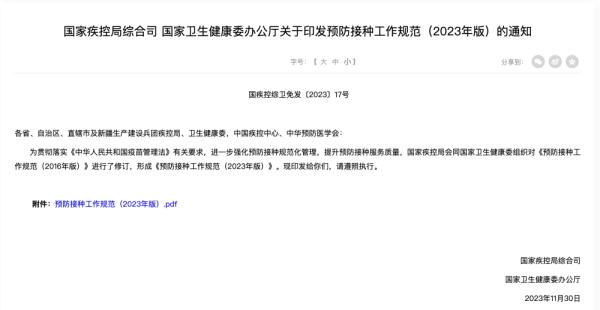
Image source: National Disease Control Bureau
The new version of the vaccination work specification puts forward standardized requirements for China’s vaccination work from the aspects of organization and responsibilities, vaccine use management, vaccination implementation, monitoring and handling of suspected abnormal reactions to vaccination, and monitoring of vaccination rate.
According to the vaccine management law and vaccination work norms, at present, vaccines in China are divided into immunization planned vaccines and non-immunization planned vaccines. Immunization planning vaccines refer to vaccines that residents should be vaccinated according to government regulations, including vaccines determined by the national immunization plan, vaccines added by the people’s governments of provinces, autonomous regions and municipalities directly under the Central Government when implementing the national immunization plan, and vaccines used for emergency vaccination or mass vaccination organized by the people’s governments at or above the county level or their disease control departments. Non-EPI vaccines refer to vaccines other than EPI vaccines voluntarily vaccinated by residents.
The specification is clear, and disease control institutions and vaccination units should establish a regular inspection system for vaccines. Disease control institutions and vaccination units should check and record the vaccines of their own units every month, including the quantity, source, packaging, storage temperature and expiration date of the vaccines. Disease control institutions and vaccination units shall truthfully record the disposal situation, including the name, quantity, marketing license holder, batch number and disposal method of the vaccine, and the disposal records shall be kept for no less than 5 years after the expiration of the vaccine. (Reporter Gu Tiancheng)
]